
Literacy activities, from first sounds to real books.
29 reading and spelling activities for Pre-K through elementary school: phonological awareness, letters, phonics, sight words, reading out loud and comprehension. Every one keeps its own report, so you see exactly which sounds, words and questions to work on next.


One path, step by step.
Start where the student is. Each step has its own activities, and each activity gets harder level by level.
- 1
Hear the sounds
Rhymes, syllables, first, middle and last sounds.
Rhyming Identification, Syllable Splash, Beginning Sounds, Sound Train
- 2
- 3
Build words
One block for each sound: c-a-t, ship, cake.
- 4
- 5
- 6
Understand what they read
Stories and real-life nonfiction, with questions.
Kindergarten literacy, standard by standard.
20 activities practice the Common Core kindergarten reading standards below. Pick the standard on the IEP or in your lesson plan and open the activity next to it.
Standards: Common Core State Standards for English Language Arts, kindergarten (RF Reading: Foundational Skills, RL Reading: Literature, RI Reading: Informational Text).
All 29 literacy activities, by skill.
Phonological awareness 11 activities
Hearing and playing with the sounds of words, before and alongside print.

Rhyming Identification
Listen to two words and decide: do they rhyme?

Rhyming Match
Listen to 7 words and find the 4 that rhyme.

Rhyming Selection
Hear a word and pick the rhyme out of 4 choices.

Syllable Splash
Count syllables in nearly 1,000 words, from 1 to 4 syllables long.

Syllable X-Ray
Find the word with the right number of syllables, from 1 to 5.

Sentence Experiment
Listen to sentences and break them into their parts.

Beginning Sounds
Find the first sound of each word, one of the first steps toward reading.

Sound Train
All aboard: blend onset and rime (c… at), find the last or middle sound, and tap the car a sound rides in.

Sound Boxes
Sound boxes: tap one box for each sound, then put a letter in each box to spell the word.

Word Chains
Change one sound to make a new word, cat to hat to hit, hopping across the river.
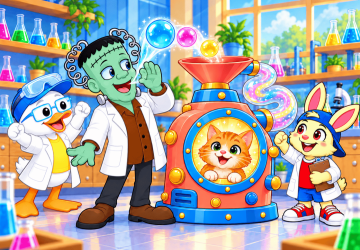
Decoding Room
Help Frankenstein's monster blend syllables and sounds into words.
Letters 3 activities
Knowing every letter by name, by sound and in cursive.

Letter Identification
Name letters and their parts together with an adult.

Letter Names
Hear a letter sound and pick the matching letter, with 2 to 4 choices.

Cursive Match
Match print letters to their cursive partners, on six levels from capitals to look-alikes and two columns to connect.
Phonics, decoding and spelling 4 activities
Connecting sounds to letters to read and spell words.

Phonics and CVC Word Builder
Build a word from its sounds, one block for each sound, then read it sound by sound or as a whole word.
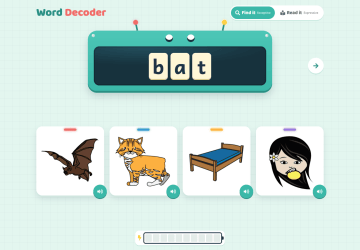
Word Decoder
Match words and pictures to build reading fluency.

Pattern Sort
Sort words by their vowel pattern: short or long a, a_e or ay, oi or oy, ou or ow.

Smarty Spell
Spelling lists by phonics pattern and more, for young spellers.
Sight words 3 activities
High-frequency and irregular words read on sight.

Heart Words Flash
Sight words flash and hide, and the student reads them on sight, in English and Spanish.

Sight Bingo
Bingo with Dolch and Fry sight words.

Listen to the Word
Tap a bus to hear a sight word, then drag the written word to the bus that said it.
Reading words, sentences and books 4 activities
Reading for meaning, out loud and on their own.

Reading Nook
Real reading out loud: little words, then decodable sentences, then little books, with every misread word marked.

Image-Text Match
See a picture and find its word among several choices.

Text-Image Match
Read a word or phrase and find its picture: 300+ words.

Read and Answer
Read simple questions about a scene and answer them. Great for reading rehab.
Comprehension 4 activities
Understanding stories and informational books, read or heard.

Reading Comprehension
55 stories at 5 reading levels with 11 question types: 605 questions in all.

Fact Finders
Six little nonfiction books read aloud: the student finds key details, the main topic and the parts of a book.

Campfire Stories
Listen to a story told around the campfire, then answer who, what, where, when, why and how questions about it, out loud or by tapping.

Sequencing Stories
50+ sequences to put in order, a step toward retelling stories.
Every literacy activity has its own report.
Each report is built around how the activity is played, so it shows what to teach next: the sounds a student misses at the end of words, the vowel pattern that slips, the heart words still being sounded out, the kind of question that trips them up.
- A sentence ready to copy into your progress note
- PDF and spreadsheet downloads
- Link a session to an IEP goal and watch the goal’s progress
- Every session in the student’s progress page, by goal and by area

Reports built for reading.
Phonics and CVC Word Builder
Built, then readThe words grouped by level, the blocks tried while building, and each reading scored sound by sound or as a whole word.
Reading Nook
Words misreadEvery sentence grouped by level with its book and page, the words misread and the words the student tapped to hear.
Sound Train
Blend, or pull apart?The words grouped by level, each with its picture and what was asked: the blend, the last or middle sound, or the sound’s place.
Fact Finders
Details, topic or parts of a book?The answers grouped by level, each naming its book and page, with the first tap counted.
Smarty Spell
First try, with a hint, or later?Each word: spelled on the first try, with a hint or later, the letters that were missed, and patterns by vowel and word length.
Reading Comprehension
Which kind of question?Each story with its 11 kinds of questions, the questions missed with the sentence to look back at, how often the hint was used, and when the next reading level may be a good step.
Listen to the Word
Words to come back toEach sight word with its first try and the tries after it, by word list.
Cursive Match
Which letters slip?The letters grouped by level, each naming its letter and the cursive letters tried before the right one.
Campfire Stories
Which kind of question?The questions grouped by kind (who, what, where, when, why, how and more), each with its story, whether the story was heard again, and a sentence for your progress note.
Letter Identification
Words to come back toThe items missed with their pictures, and a sentence for your progress note.
For everyone who teaches reading.
- SLPs working on phonological awareness, which speech sound and language goals often share
- Reading specialists and interventionists who need daily practice and data on decoding and sight words
- Special education teachers with students at different levels in the same group: up to 4 students, each at their own level
- Families, through home practice from each student’s own login
Literacy in Spanish too.
12 literacy activities play in Spanish, with Spanish words and recordings: Syllable Splash, Beginning Sounds, Letter Identification, Letter Names, Cursive Match, Heart Words Flash, Sight Bingo, Listen to the Word, Image-Text Match, Text-Image Match, Read and Answer, Sequencing Stories.
Frequently asked questions.
Which literacy skills does Smarty Ears Online cover?
29 activities across phonological awareness, letters, phonics and spelling, sight words, reading out loud, and comprehension of stories and informational books. Every one has its own report.
Which activities work for kindergarten?
20 activities practice the kindergarten reading standards on this page: letters (RF.K.1.d), rhyme, syllables and sounds (RF.K.2), phonics and sight words (RF.K.3), emergent-reader texts (RF.K.4), key details in stories (RL.K.1) and informational books (RI.K.1–9). Each one also has easier and harder levels for the students around kindergarten.
What ages are the literacy activities for?
From Pre-K through elementary school and beyond: the first-sound, rhyme and letter activities start in Pre-K, and spelling, pattern sorting and reading comprehension go up to middle school. You set the level for each student.
How do I see a student’s progress?
Every activity has its own report, built around how it is played: the words built, misread or spelled, the sounds and patterns that slip, the questions missed, and a sentence ready for your progress note. Download it as a PDF or a spreadsheet, or link the session to an IEP goal.
Are the literacy activities in Spanish?
12 of them are: Syllable Splash, Beginning Sounds, Letter Identification, Letter Names, Cursive Match, Heart Words Flash, Sight Bingo, Listen to the Word, Image-Text Match, Text-Image Match, Read and Answer, Sequencing Stories.
Can I use them with a group or in teletherapy?
Yes. Play with up to 4 students at once, each with their own level and scores, at the table or by sharing the browser tab in Zoom, Teams or Meet.
Can students practice at home?
Yes. Assign activities for home practice and students play them from their own login, with the results in the same reports.
Is it a dyslexia program?
No. It is practice and progress data for the skills reading intervention works on: sounds, letters, decoding, sight words and reading out loud, one step at a time. Use it alongside the program and goals you already follow.
Which plan includes the literacy activities?
Every plan includes all 100+ activities, the literacy ones too. Try it free for 14 days; after that Basic Professional is $29 a month.
Try all 29 literacy activities free for 14 days
Every plan includes all 100+ activities and their reports. Then it’s $29 a month.
